


Powerful Data Architecture For Effortless Business Growth
In today’s digital world, data isn’t just an asset, it’s the heartbeat of every smart decision, every customer experience, and every business transformation. Yet, for many organizations, data still feels messy, scattered, and unreliable. Reports don’t match, dashboards create confusion, and teams waste hours debating numbers instead of acting on them. This is where powerful data architecture becomes more than just a technical framework it becomes a source of real confidence.
A well-designed data architecture brings clarity to chaos. It ensures that your data is structured, secure, scalable, and easily accessible across the business. More importantly, it builds trust that the numbers are accurate, the insights are meaningful, and the decisions you’re making are backed by reliable foundations. Whether you’re scaling a startup, modernizing legacy systems, or building a cloud-first strategy, the right architecture doesn’t just support growth it empowers it.
In this article, we’ll explore what makes data architecture truly powerful, how it supports long\ term success, and why it’s the key to building confidence in analytics, operations, and leadership decisions. If you’re ready to turn your data into a strategic advantage, you’re in the right place.
You need a solid foundation for your data. Your business depends on it. Data architecture gives you that foundation, and it transforms how you collect, store, and use information across your organization.
What Is Data Architecture?
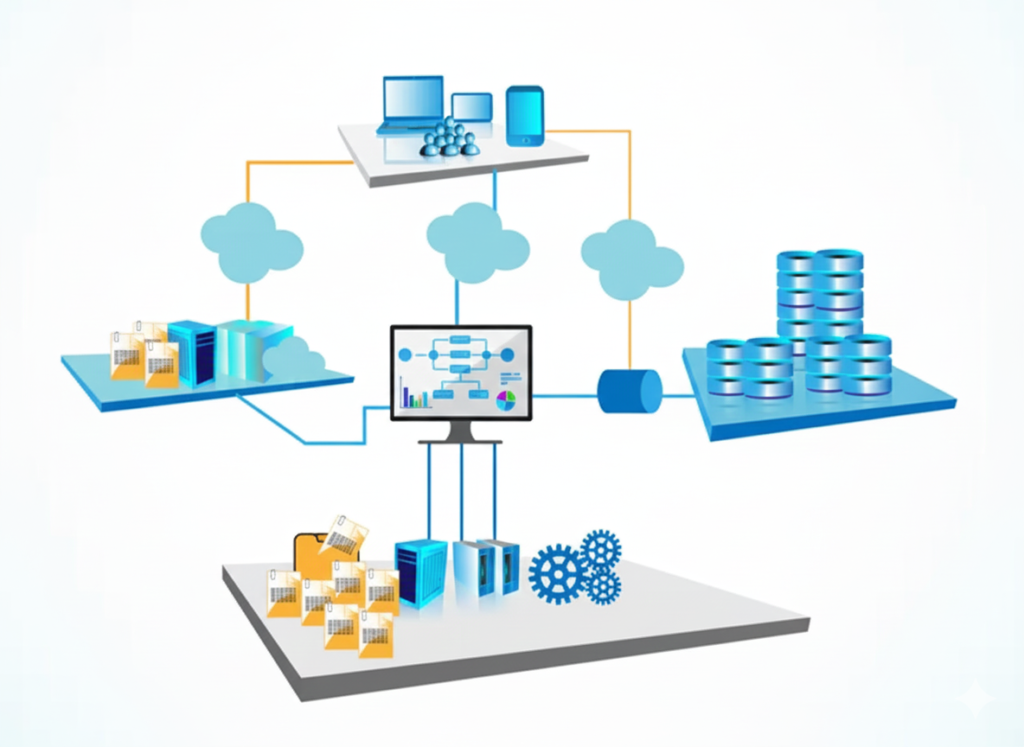
Data architecture defines how your organization structures, manages, and moves data. It acts as a blueprint for your entire data ecosystem. You get clear rules and standards that govern everything from collection to analysis.
Think of it as the skeleton of your data environment. Every component connects to support your business goals. The framework includes databases, applications, and the pathways between them.
According to Gartner’s 2024 research, organizations with well-defined data architecture report 3.2x faster decision-making speeds compared to those without structured frameworks. Your team can access the right data at the right time, and this creates measurable business impact.
Why Does Your Business Need Data Architecture?
Your data sits scattered across multiple systems. You face delays when teams need information. Data architecture solves this problem by creating a unified view of all your assets.
You eliminate data silos that slow down operations. Teams can collaborate using the same information sources. This reduces errors and improves accuracy across departments.
A 2023 IDC study found that poor data quality costs organizations an average of $12.9 million annually. Strong architecture prevents these losses by establishing clear data governance rules from the start.
How Does Data Strategy Connect to Architecture?
Data strategy sets your direction. Architecture makes that direction actionable. You define what you want to achieve with data, and architecture provides the roadmap to get there.
Your strategy answers questions about business objectives. Architecture translates those answers into technical specifications. The two work together to drive value from your data assets.
Leaders often confuse strategy with architecture. Strategy focuses on the “what” and “why.” Architecture handles the “how” and “where.” You need both to succeed in modern data management.
What Are the Core Components of Data Architecture?
Your data architecture consists of several critical elements. Each component serves a specific purpose in your overall framework.
Data Modeling
You create representations of your data structures through modeling. This defines relationships between different data entities. Models show how information flows through your systems.
Conceptual models give you a high-level view. Logical models add more detail about data relationships. Physical models specify exactly how databases store your information.
Data Integration
You connect disparate systems through integration. Data moves between applications, databases, and platforms seamlessly. Integration ensures consistency across your entire environment.
ETL (Extract, Transform, Load) processes handle this movement. APIs create real-time connections between systems. Your integration approach depends on your specific business needs.
Metadata Management
You track information about your data through metadata. This includes details like data sources, update times, and ownership. Metadata helps users understand and trust your data.
Research from The Data Warehousing Institute shows that organizations with active metadata management reduce data discovery time by 57%. Your teams spend less time searching and more time analyzing.
Master Data Management (MDM)
You maintain a single, authoritative source for critical data through MDM. Customer information, product details, and supplier data all need consistency. MDM eliminates duplicates and conflicting records.
Your sales team sees the same customer data as your support team. This creates better experiences and more accurate reporting. MDM forms the backbone of reliable data governance.
How Do You Build Effective Data Governance?
Data governance defines who can access and modify your data. You establish clear ownership and accountability. Rules protect sensitive information and ensure compliance.
Your governance framework includes policies, procedures, and standards. Data stewards oversee specific domains. They ensure quality and compliance within their areas.
According to a 2024 report by MIT CDOIQ, companies with mature data governance programs achieve 35% better regulatory compliance outcomes. You avoid costly fines and reputational damage.
What Role Does Data Quality Play?
Poor quality data undermines every decision you make. You need accurate, complete, and timely information. Data quality measures ensure your architecture delivers reliable results.
You implement validation rules at entry points. Automated checks catch errors before they spread. Regular audits identify quality issues in existing data.
Data profiling reveals patterns and anomalies. You understand the current state of your data landscape. This knowledge guides improvement efforts and prevents future problems.
How Does Data Lineage Improve Trust?
Data lineage traces information from origin to destination. You see exactly where data comes from and how it changes. This transparency builds confidence in your analytics.
Business users can verify the source of any report or dashboard. Technical teams can troubleshoot issues faster. Lineage documentation becomes your roadmap for data movement.
A 2023 survey by Forrester found that 68% of data leaders cite lineage as critical for regulatory compliance. You demonstrate data handling to auditors with clear documentation.
What Security Measures Protect Your Data?
Your data architecture must include robust security controls. You protect sensitive information from unauthorized access. Security measures prevent breaches and maintain customer trust.
Encryption safeguards data both in storage and during transmission. Access controls limit who can view or modify information. Authentication verifies user identities before granting access.
Data masking hides sensitive details in non-production environments. You can test and develop without exposing real customer information. Security becomes part of your design, not an afterthought.
How Do You Manage the Data Lifecycle?
Data has a lifespan. You create, use, archive, and eventually delete information. Lifecycle management defines rules for each stage.
Active data stays in high-performance systems for quick access. Older data moves to cheaper storage as usage declines. You delete data when legal retention periods expire.
According to ESG research, organizations with defined lifecycle policies reduce storage costs by an average of 43%. You save money while maintaining compliance with retention requirements.
What Are the Key Principles for Implementation?
Several core principles guide successful data architecture implementation. You should apply these throughout your design process.
Scalability First
Your architecture must grow with your business. You plan for increased data volumes and user demands. Scalable designs prevent costly rebuilds as needs evolve.
Cloud platforms offer elastic resources that expand on demand. Distributed architectures handle larger workloads efficiently. You build capacity into your foundation from day one.
Business Alignment
Technology serves business objectives. You align every architectural decision with strategic goals. This ensures your investment delivers measurable value.
Stakeholder input shapes your design choices. You understand how different teams use data. Architecture reflects actual workflows, not theoretical ideals.
Flexibility and Adaptability
Business requirements change constantly. Your architecture accommodates new data sources and use cases. Rigid systems become obstacles instead of enablers.
Modular designs allow component replacement without full redesigns. Standard interfaces make integration easier. You future-proof your environment through thoughtful flexibility.
Data as an Asset
You treat data like any valuable business asset. Clear ownership, protection, and management practices apply. Architecture supports data’s role as a competitive advantage.
Data catalogs make assets discoverable across the organization. Quality metrics track asset value over time. You maximize returns on your data investments.
How Do You Choose the Right Architecture Pattern?
Different business needs require different architectural approaches. You select patterns based on your specific requirements and constraints.
Centralized Architecture
All data flows to a single repository. You gain consistency and control. Central systems simplify governance and security.
Data warehouses exemplify this pattern. Analytics teams access one unified source. Centralized approaches work well for structured, transactional data.
Distributed Architecture
Data stays closer to where you generate and use it. This reduces latency and improves performance. Distributed systems handle larger volumes more efficiently.
Data lakes store raw information in native formats. Processing happens where data resides. You gain flexibility but face more complex governance.
Hybrid Architecture
You combine centralized and distributed elements. Critical data centralizes for governance. Less sensitive data remains distributed for performance.
Most modern organizations adopt hybrid approaches. You balance control with flexibility. The pattern adapts to diverse business requirements.
What Technologies Support Modern Data Architecture?
Technology choices depend on your architecture pattern and business needs. Several categories of tools support different aspects of your framework.
Cloud platforms like AWS, Azure, and Google Cloud provide scalable infrastructure. You avoid capital expenses and gain flexible capacity. Cloud services include built-in security and compliance features.
Data warehouses such as Snowflake and BigQuery optimize analytical workloads. They separate storage from computers for better performance. You pay only for resources you actually use.
Data lakes built on object storage handle vast amounts of raw data. Tools like Databricks and AWS Lake Formation add structure and governance. Lakes support both structured and unstructured information.
Integration platforms connect your various systems. Apache Kafka handles real-time data streams. ETL tools like Informatica and Talend manage batch processing.
How Do You Measure Architecture Success?
You need concrete metrics to evaluate your data architecture. These measurements show whether your investment delivers expected returns.
Data accessibility tracks how quickly users find needed information. You monitor time from request to insight. Reduced search time indicates better organization and cataloging.
System performance measures query response times and throughput. Faster queries mean better user experiences. Performance benchmarks help identify bottlenecks.
Data quality scores assess accuracy, completeness, and consistency. You track improvement over time. Higher quality leads to better decisions and outcomes.
A recent Deloitte study shows that organizations with comprehensive data metrics achieve 2.5x higher ROI on data initiatives. You demonstrate value to stakeholders with clear measurements.
What Common Mistakes Should You Avoid?
Many organizations stumble during architecture implementation. You can learn from these common pitfalls and avoid costly errors.
Overcomplicating the initial design creates unnecessary delays. You should start simple and expand as needs evolve. Perfect becomes the enemy of good in architecture projects.
Neglecting stakeholder input leads to solutions that don’t fit actual needs. You must involve business users throughout the design process. Their feedback ensures practical, usable outcomes.
Ignoring existing systems causes integration headaches later. You need to understand your current landscape before designing the future. Legacy systems often contain valuable data and processes.
Underestimating governance requirements creates compliance risks. You should build security and privacy controls from the beginning. Adding governance after implementation costs far more.
How Does Architecture Enable Advanced Analytics?
Strong data architecture makes advanced analytics possible. You create the foundation for machine learning, AI, and predictive modeling.
Clean, well organized data trains better models. Your algorithms learn from reliable information. Architecture ensures data scientists spend time analyzing, not cleaning.
Feature stores provide reusable data transformations. You avoid duplicating work across projects. Standardized features improve model consistency and performance.
Model deployment requires robust data pipelines. Real-time predictions depend on fresh, accurate data. Architecture supports the entire ML lifecycle from training to production.
What Future Trends Shape Data Architecture?
The data landscape continues to evolve rapidly. You need to prepare for emerging trends and technologies.
Data fabric architectures create intelligent, self service environments. Automated discovery and integration reduce manual work. You gain agility without sacrificing governance.
Edge computing processes data closer to sources. IoT devices generate massive volumes at the network edge. Architecture adapts to support distributed processing.
Real-time streaming becomes the default for many use cases. Batch processing no longer meets business speed requirements. You design for continuous data flow and immediate insights.
Gartner predicts that by 2025, 70% of organizations will shift from big data to small and wide data for analytics, placing more emphasis on context than volume. Your architecture must support diverse data types and sources.
How Do You Get Started with Data Architecture?
Starting seems overwhelming, but you can break it into manageable steps. A phased approach delivers value while building toward your vision.
Assess your current state first. You document existing systems, data flows, and pain points. This baseline shows where you are today.
Define your target state based on business objectives. You create a vision that aligns with strategy. Clear goals guide design decisions throughout the project.
Prioritize quick wins that demonstrate value. You implement changes that deliver immediate benefits. Early success builds momentum and stakeholder support.
Build incrementally rather than attempting everything at once. You launch phases that each add capability. Iterative development reduces risk and allows course correction.
Invest in skills and training for your team. Data architecture requires specialized knowledge. You develop internal expertise to sustain long-term success.
Your data architecture journey transforms how you compete and operate. Strong foundations enable faster decisions, better insights, and sustainable growth. Start building that foundation today.
FAQ
What is data architecture?
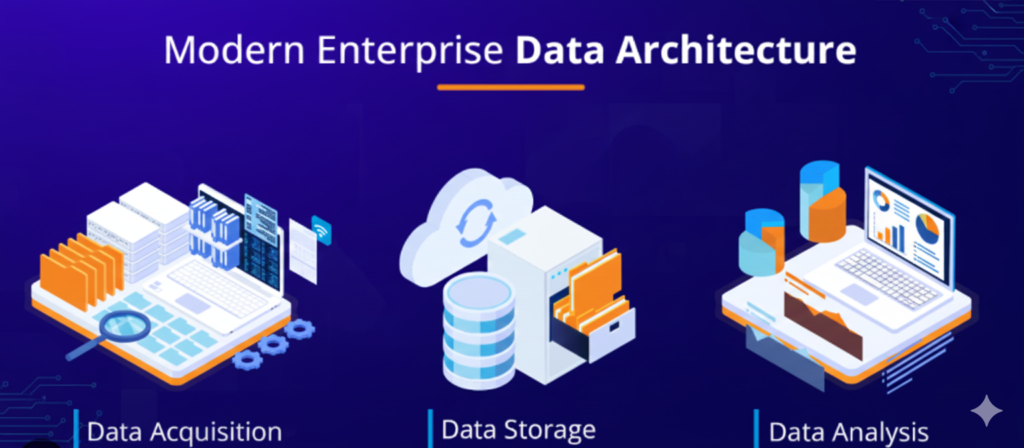
Data architecture is a blueprint that defines how data is collected, stored, processed, managed, and accessed across an organization. It ensures data remains consistent, secure, and scalable for analytics and decision-making.
Why is data architecture important?
Data architecture is important because it helps businesses avoid data chaos, reduce inconsistency, and improve trust in reports. A strong architecture supports faster insights, better decisions, scalability, and compliance.
What are the key components of data architecture?
The main components of data architecture typically include:
- Data sources
- Data ingestion (batch/stream)
- Storage (data lake, warehouse, lakehouse)
- Data modeling and transformation (ETL/ELT)
- Data governance and security
- Metadata and data catalog
- Monitoring and data quality controls
What is the difference between data architecture and data engineering?
Data architecture focuses on the overall design and strategy of data systems, while data engineering focuses on building and maintaining pipelines, transformations, and infrastructure that implement the architecture.
How does data architecture build confidence in data?
It builds confidence by ensuring data is accurate, consistent, well-governed, and accessible. When teams trust dashboards and reports, they make decisions faster and stop wasting time on which numbers are correct.
What is a modern data architecture?
Modern data architecture usually includes cloud-based systems, scalable storage, automated pipelines, and governance tools. It often uses approaches like lakehouse, data mesh, or data fabric to support real-time and advanced analytics