

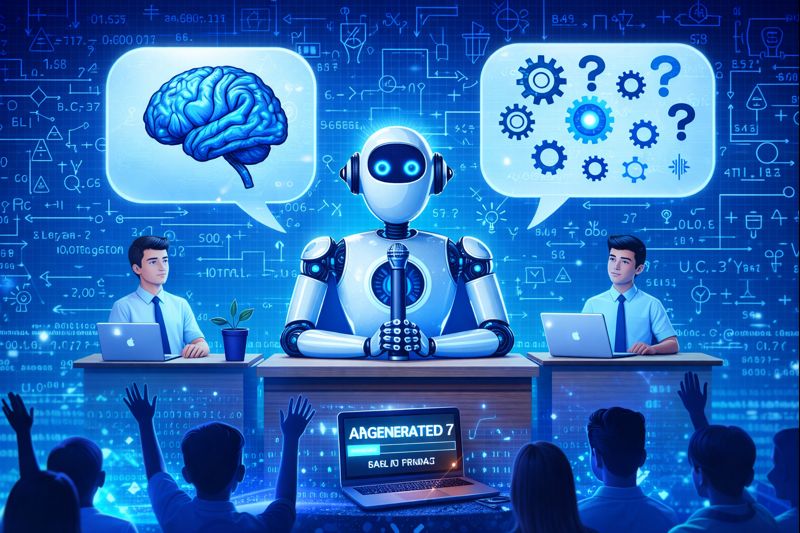
Do UCs Use AI Detectors? Shocking Truth Revealed
The rapid rise of artificial intelligence has reshaped how students learn, write, and prepare for college. From brainstorming ideas to refining sentence flow, many students now use AI tools at some point during their academic journey
This shift has created deep anxiety among applicants, especially those applying to the University of California (UC) system
One question dominates student forums, counseling offices, and social media discussions:
Do UCs use AI detectors?
This article provides a clear, honest, and student-friendly answer. It explains how UC schools actually review applications, whether AI detection tools are used, why AI detection is unreliable, and what students should truly focus on to succeed. Most importantly, it aims to reduce fear and replace confusion with clarity
Why This Question Matters More Than Ever
College admissions have always been stressful, but the introduction of generative AI has added a new layer of uncertainty. Students worry that:
- Their college essays might be flagged as AI-generated content
- False positives could damage their chances
- An automated AI checker might override human judgment
- One mistake could negatively impact admissions decisions
These fears are especially strong among students applying to competitive institutions like UC Berkeley, UC San Diego, UC Davis, UC Santa Barbara, UC Riverside, and UC Irvine
Understanding the reality behind these concerns is essential for making smart, ethical, and confident choices
Understanding the University of California System
The University of California system is one of the largest and most respected public higher education systems in the world. It serves millions of applicants and students across multiple campuses and academic disciplines
Unlike private institutions that rely heavily on supplemental materials, the UC system uses a standardized UC application that includes:
- Academic records
- Activities and awards
- Personal Insight Questions (often referred to as UC essays)
Each application is reviewed using a holistic review process, meaning no single factor test scores, GPA, or writing style, determines admission
Does UC Use AI Detectors?
The Direct Answer
Does UC use AI detectors?
There is no official policy stating that the UC system uses AI detection software as a deciding factor in undergraduate admissions
Admissions decisions are made through human review, not automated judgment. While universities are aware of AI detection systems, there is no evidence that AI detection scores are used to automatically accept or reject applicants
How UC Applications Are Actually Reviewed
A Human-Led Review Process
Applications submitted to UC schools are evaluated by trained readers who focus on:
- Academic preparation
- Depth of involvement
- Personal growth
- Evidence of critical thinking
- Authentic reflection in student work
Readers are trained to understand context. They know students come from different high school backgrounds, cultures, and educational systems
The goal is not to find “perfect” writing but to understand the student behind the words
Why AI Detection Tools Are Not Reliable for Admissions
1. AI Detectors Are Not Accurate Enough
Most AI detection tools are based on probability, not certainty. They analyze AI patterns, sentence predictability, and stylistic features, but they cannot definitively prove authorship
Even advanced AI detection systems struggle with:
- Short essays
- Personal narratives
- Edited drafts
- Mixed human-AI writing
This creates serious accuracy concerns, especially for high-stakes decisions
2. False Positives Harm Innocent Students
One of the biggest risks of AI detection is false positives. A student’s original essay can be incorrectly labeled as AI-generated text simply because it is:
- Clear
- Well-structured
- Grammatically strong
- Written in a mature writing style
Students interested in computer science, strong writers, or those who practice extensively are often unfairly flagged unfairly
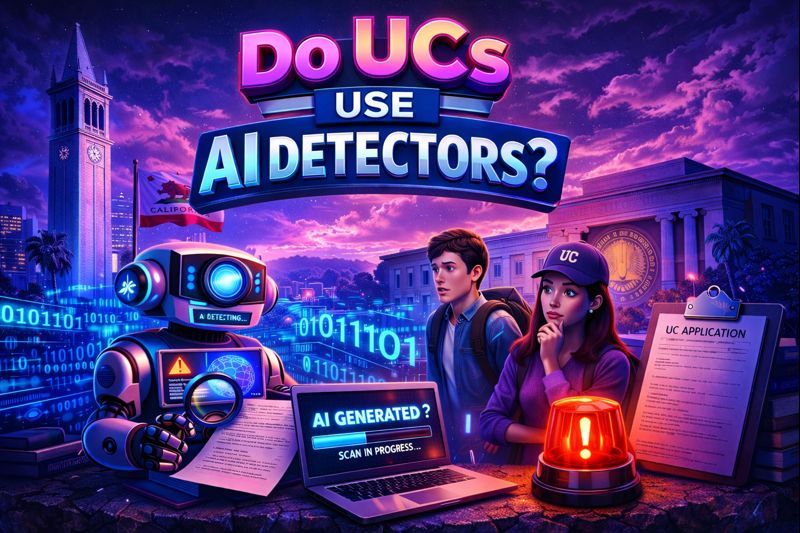
3. Bias in AI Detection Systems
Studies have shown that AI detectors may disproportionately flag:
- Non-native English speakers
- International applicants
- Students from underrepresented backgrounds
This raises ethical issues tied to AI ethics, fairness, and equal access in higher education
The Difference Between AI Detection and Plagiarism Detection
Many students confuse plagiarism detection with AI detection, but they are not the same
Plagiarism Detectors
A plagiarism checker compares text against existing databases to see if content was copied. These tools are relatively reliable and widely used in academic settings
AI Detectors
AI detectors attempt to guess whether content was generated by language models. They do not compare against sources and cannot verify originality
Tools like Turnitin AI combine both approaches, but even Turnitin acknowledges that AI detection results should not be used as definitive proof
Do UC Schools Use Turnitin AI?
Turnitin AI is primarily used for coursework, not admissions essays. Its role is to support instructors in maintaining academic integrity, not to serve as an admissions gatekeeper
There is no public evidence that UC admissions offices rely on Turnitin AI detection results during the application review process
What About Other Universities?
The UC system is not alone in this approach. Many top institutions—including:
- Yale University
- Princeton University
- Stanford University
- Massachusetts Institute of Technology
- California Institute of Technology
- University of Pennsylvania
- University of Michigan
- Penn State
- UNC Chapel Hill
- University of Southern California
have publicly stated that AI detection tools are unreliable for admissions. Even Ivy League schools emphasize human judgment over automation
What Admissions Offices Actually Look For
Authentic Voice Matters Most
Admissions readers are trained to recognize an authentic voice. They look for essays that reflect:
- Personal experiences
- Honest reflection
- Growth and learning
- Clear reasoning
- Individual perspective
Perfect grammar does not impress readers if the essay lacks meaning
AI Tools vs. AI Misuse
Responsible Use of AI
Using AI tools responsibly can support learning. Examples include:
- Brainstorming topics
- Improving clarity
- Checking grammar
- Structuring ideas
This kind of support does not automatically violate policies.
Misuse of AI
Problems arise when:
- Entire essays are submitted as AI-generated content
- Students cannot explain or defend their writing
- The essay lacks personal depth
This can raise red flags, but again, those flags are reviewed by humans
What Happens If an Essay Raises Concerns?
No Automatic Rejection
If an essay seems unusual, admissions readers may:
- Compare it with other parts of the application
- Look for consistency in tone
- Apply judgment and discretion
There is no evidence of applications being rejected solely due to an AI detection alert
Fraud Policy and Academic Integrity
The UC system maintains a fraud policy to prevent misrepresentation. This includes:
- Submitting work written by someone else
- Providing false information
- Copying content intentionally
Using AI as a support tool does not automatically violate these rules
Common Myths About AI Detectors and UC Admissions
Myth 1: AI Detection Systems Decide Admissions
False. Admissions decisions are human-driven.
Myth 2: A High Detection Score Means Rejection
False. Detection Score values are not official criteria.
Myth 3: Using AI at All Is Prohibited
False. There is no blanket ban on AI assistance
Best Practices for Students Applying to UC Schools
1. Focus on the Writing Process
Show thinking, reflection, and growth.
2. Keep Your Voice Natural
Avoid over-editing or robotic phrasing.
3. Use AI Carefully
AI should support, not replace, your thinking.
4. Be Honest
Authenticity is more valuable than perfection.
5. Don’t Obsess Over AI Checkers
Admissions readers care more about meaning than AI detection features
Should Students Use an AI Humanizer?
Some students use an AI humanizer to reduce stiffness. While this can help with flow, it should never replace personal insight or originality
Readers value sincerity over polish
The Role of AI in the Future of Higher Education
AI is becoming part of education, not an enemy of it. Universities are adapting by:
- Updating policies
- Educating faculty
- Encouraging ethical technology use
The UC system’s approach reflects a broader understanding that human review remains essential
Conclusion
Do UCs use AI detectors?
There is no evidence that the UC system uses AI detectors as a decisive factor in admissions. While AI detection software exists, it is too unreliable to determine a student’s future
Admissions decisions are based on:
- Context
- Content
- Consistency
- Human judgment
Key Takeaway for Students
If a student’s essay demonstrates:
- Original thought
- Honest reflection
- Strong reasoning
- Personal growth
It will stand on its own regardless of AI rumors
FAQs
Do UCs use AI detectors for admissions essays?
There is no official confirmation that the University of California system uses AI detectors as a deciding factor in undergraduate admissions. UC applications are reviewed by trained human readers who focus on the student’s ideas, experiences, and authentic voice rather than relying on automated tools
Can UC schools detect AI-generated content in UC essays?
UC schools may notice essays that feel generic or lack personal detail, but AI detection tools are not accurate enough to confirm whether content was generated by AI. Admissions officers rely on human judgment, context, and consistency across the application instead of automated detection results
Does UC Berkeley use AI detection software like Turnitin AI?
Turnitin AI is mainly used for coursework and plagiarism detection after students are enrolled. There is no public evidence that UC Berkeley or other UC campuses use Turnitin AI to evaluate admissions essays during the admissions review process
Do UC San Diego, UC Irvine, or other UC schools use AI detection systems?
There is no public policy stating that UC San Diego, UC Irvine, or other UC schools use AI detection systems for admissions decisions. The UC system emphasizes holistic review and human evaluation rather than automated screening
Are AI detection tools accurate for college essays?
AI detection tools have serious accuracy concerns. They often produce false positives, meaning human-written essays can be incorrectly flagged as AI-generated text. Because of this unreliability, many colleges and universities avoid using AI detection results in high-stakes decisions like admissions