
AI Transformation Is a Problem of Governance in 2026, Not Technology
In boardrooms, I have seen companies treat artificial intelligence as if it were mainly a technology challenge: approve the budgets, hire a few data science hires, expand cloud capacity, upgrade infrastructure, and expect the models to transform the enterprise.
The early pilots often look convincing, the proof-of-concept feels promising, and the executive presentations make every roadmap sound inevitable.
But once those same AI initiatives touch real customer service, underwriting, diagnostics, logistics, hiring, forecasting, or fraud detection, the gap between technical excitement and operational reality becomes obvious.
What Does AI Transformation Is a Problem of Governance Really Mean?
Governance vs Management vs Technology
I’ve seen many teams confuse governance, management, and technology until an AI project reaches real deployment and the pressure exposes the gaps. Technology builds the system, management operates it, but governance creates the structure, rules, authority, and clarity that decide who is empowered to act, who approves, who signs off, and who carries responsibility when the consequences become serious.
That is the real governance problem in the AI era: without strong oversight, clear accountability, and regular reviews, an organization cannot safely use AI in high-risk contexts. Someone must define acceptable error thresholds, track model drift, and decide how much harm is tolerable before intervention is required. Otherwise, even a well-built system becomes an unmanaged force inside the business.
Decision Rights in the AI Era
In the past, human managers made choices through clear reporting lines, but the rise of automated decisions has changed how power moves inside a company. I’ve seen one AI model flag a fraudulent transaction, a recruitment algorithm rank candidates, and a predictive model adjust pricing before anyone outside the technical team fully understood who owned the outcome.
When a wrong decision happens, accountability can quickly blur across data teams, product managers, compliance officers, and business leaders. That is why governance must define decision rights early, before a crisis forces painful clarity.
Why Your AI Strategy Keeps Failing (And It’s Not the Tech)
I’ve watched organizations rush into enterprise AI adoption like a race car with no brakes or steering wheel, full speed, maximum capability, and plenty of power, but zero control mechanisms. Leadership assumes teams will maintain direction, yet without a structured approach and clear adoption plans, projects stall, frustration builds, and initial confidence evaporates.
The result is that even the most promising AI initiatives fail, not because of technology, but because direction and governance are missing from the strategy.

What Makes AI Governance Different from Regular IT Management
Unlike traditional software or a Microsoft Excel spreadsheet that behaves predictably from Monday to Friday, AI systems don’t follow a fixed pattern. I’ve seen email clients and other tools maintain deterministic behavior, but AI models evolve with data consumption, producing probabilistic outputs that can generate unexpected results tomorrow, even if everything seemed stable yesterday.
This unpredictability is what makes oversight so critical; oversight structures must account for messages the system sends, the dangerous consequences of misalignment, and the fact that AI rarely behaves in a predictable way.
Managing AI isn’t just about controlling tools; it’s about anticipating how these systems will evolve, monitoring for unexpected results, and building frameworks that prevent small errors from escalating into serious problems.
Whereas conventional IT management can rely on repetition and consistency, AI governance must embrace uncertainty and design structures that can respond dynamically to outcomes that are inherently probabilistic.
| Traditional Software | AI Systems |
| Static behavior | Dynamic and evolving |
| Predictable outputs | Probabilistic results |
| Clear accountability | Blurred responsibility lines |
| Simple compliance | Complex regulatory requirements |
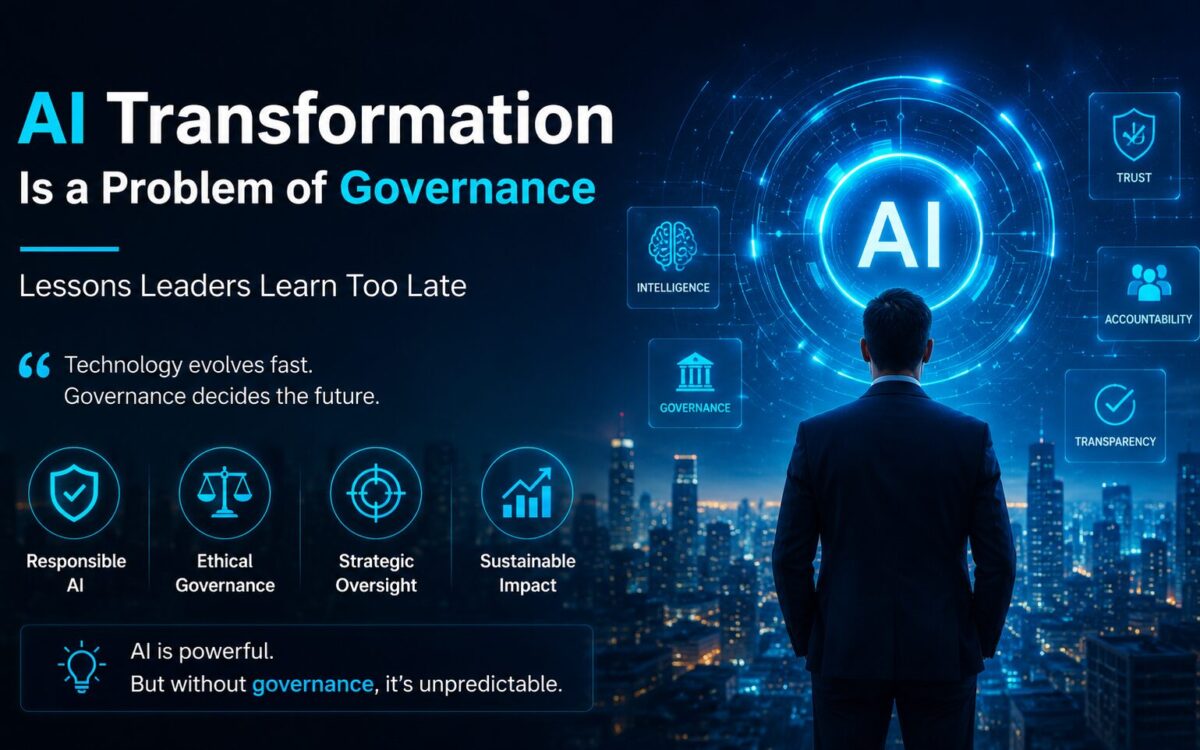
Why AI Transformation Is a Problem of Governance, Not Technology
From my experience working with multiple organizations, it’s clear that AI transformation fails not because of immature technology or lack of capabilities, but because of weak governance. Failing AI initiatives often suffer from unclear ownership, inconsistent reporting mechanisms, and missing board-level oversight, which leaves AI systems running as fragmented experiments rather than contributing real business value.
Without proper accountability, strategic alignment, and direction, AI projects produce duplicated efforts, uncontrolled risks, and compliance gaps, while ethical concerns go unnoticed, threatening sustainable success across enterprise-wide transformation.
A more practical approach begins with embedding governance structures early, connecting investments to measurable outcomes, and ensuring risk management is central to every AI project. When organizations treat AI purely as technology, the context is lost, direction wavers, and AI systems underdeliver.
Success comes from aligning the capabilities of AI with clear ownership, robust oversight, and a vision that transforms experimental projects into true enterprise-wide transformation.
Why AI Transformation Has Become a Governance Challenge
In my experience, AI initiatives often start at the departmental level, with marketing teams adopting automation tools, finance building forecasting models, and operations using machine learning for process optimization.
These individual projects can deliver quick wins, but without centralized governance, organizations expose themselves to long-term risks that threaten the overall AI transformation effort. Success in AI is not just about tools or models; it’s about creating a framework where local experimentation scales safely across the enterprise.
Common Governance Gaps That Derail AI Success
I’ve seen AI strategy fail repeatedly when leadership accountability is unclear, and AI initiatives operate as fragmented efforts without alignment to strategic direction or business objectives. Even with board-level reporting and high-level updates, boards struggle to understand the risks and business impact of AI, leaving strategic alignment inconsistent and creating gaps across departments. In such environments, data standards, data formats, definitions, and quality controls are uneven, leading to AI outputs with errors, bias, and operational inefficiencies that undermine performance.
Weak risk management processes and poorly implemented AI risk frameworks make organizations vulnerable to critical issues like model bias, security vulnerabilities, and regulatory non-compliance, often resulting in unintended consequences.
Without ethical frameworks, compliance frameworks, or clear AI ethics policies and controls, organizations face discrimination, privacy violations, regulatory penalties, and reputational damage. AI systems touch critical decisions from pricing and hiring to credit approvals and supply chain operations, making these gaps particularly dangerous.
An IT project with inadequate governance affects customers, employees, financial performance, and brand reputation, leading to legal liabilities, financial losses, and strategic failure for companies. Closing these governance gaps is not just about compliance; it’s about ensuring that AI delivers on its promise while protecting the enterprise at every level, from policy to deployment.
Why AI Transformation is a Problem of Governance: A Deeper Explanation
I’ve seen organizations treat enterprise AI adoption like another rollout of traditional software, but AI systems are nothing like Microsoft Excel or a CRM system that behaves the same on Monday as it does on Friday. Deterministic models follow fixed logic; AI creates probabilistic outputs shaped by data consumption, which means AI outputs can shift from useful yesterday to unexpected results or even damaging results tomorrow.
That is why the old legacy IT governance playbook breaks down: the same models that deliver impressive capability can also create accountability gaps, such as a biased hiring decision or an erroneous financial recommendation, unless governance is built around the new structural realities of AI.
The simplest way I explain this to executives is the race car test: buying speed without brakes, a steering wheel, or real control mechanisms does not create performance; it creates crashes without direction. The same is true when companies ignore shadow AI proliferation, where employees paste confidential data into public chatbots, move customer records into unlicensed tools, or avoid sanctioned alternatives because they feel too slow.
Add regulatory exposure- the EU AI Act, 2026, penalties, GDPR fines, and the absence of a real governance framework- and AI stops looking like a pure technology upgrade and starts looking like an enterprise risk system that must be governed before it is scaled.
When lack of governance brings catastrophe: real-world examples
Theory becomes vivid when you examine what happens in the absence of robust AI governance. These cases represent the cost of moving fast without guardrails.
Amazon’s Biased Recruitment AI (2018)
The Amazon case is one I often use when explaining how a promising machine-learning recruiting tool can turn into a serious governance failure. The AI was trained on historical hiring data shaped by years of male-dominated tech hiring, so its model outputs quietly learned to downgrade CVs from women and influence hiring decisions before the full problem was visible. In practice, the project did not fail only because of biased data;
it failed because there was no strong governance layer, no independent audit, no data integrity protocol, no bias audit framework, and no human-in-the-loop checkpoint to challenge the system before it affected real recruiting outcomes.
Knight Capital’s $440 Million Algorithmic Disaster (2012)
One of the clearest examples of what happens when governance processes are ignored involves Knight Capital and an untested trading algorithm that wiped out $440 million in a single day. A piece of dormant code was accidentally reactivated during a routine software update, and without proper change-management controls, deployment validation, or real-time monitoring, the system executed thousands of unintended trades.
The algorithm’s trading execution spiraled out of control, leaving the firm reliant on an emergency bailout to cover the losses. This incident illustrates that even the most sophisticated algorithm can fail catastrophically when oversight is missing.
IBM Watson for Oncology Unsafe Treatment Recommendations
In my experience, the IBM Watson Health rollout across hospitals highlights how healthcare AI can go wrong when governance is insufficient. Internal documents revealed that the AI system produced unsafe treatment recommendations and incorrect treatment recommendations in multiple cases, often relying on hypothetical patients suggested by a few physicians rather than real patient data.
Without a proper validation framework or oversight mechanism to compare treatment outputs against clinical evidence, the system issued dangerous recommendations, prompting many hospitals to quietly abandon the system before patient safety was compromised.
Apple Card’s Alleged Gender Discrimination (2019)
The Apple Card case is a useful reminder that a credit-limit algorithm can create serious trust issues when it operates like a black box. After customers reported that women received lower credit limits than their husbands, even with stronger credit scores, the issue triggered a regulatory investigation and raised questions about how the algorithm was making decisions.
In practice, the deeper problem was the lack of governance structures: no clear explainability framework, no bias-testing protocol, no reliable audit trail, and no routine fairness audits to prove transparency or detect systemic discrimination before it continued for months.
Conclusion
Looking ahead at AI in 2026, companies will have access to powerful models and big data sets, but success won’t come from technology alone it will come from trust, transparency, and accountability embedded in disciplined oversight.
Organizations that treat AI transformation as a governance challenge rather than a pure tech upgrade will protect customers’ trust, employees’ safety, and regulatory standing, while building organizational resilience that lasts beyond the next model or data cycle.
I often use the race car analogy to explain this: raw speed and cutting-edge AI without steering or brakes can look impressive but lead to a crash. By combining performance with careful direction, confidence, and the ability to accelerate safely, companies can turn experimental AI projects into reliable enterprise assets that scale responsibly and strategically.
FAQ
How does AI affect governance?
AI changes governance by helping governments use vast datasets to analyze trends, predict trends, track economic trends, assess challenges, address social challenges, and improve policy formulation through data-driven policymaking.
How is AI affecting the government?
AI is reshaping government operations by improving mission-support functions like human resources, finance, procurement, and grants management without adding headcount.
What are the challenges of AI governance?
AI governance challenges often come down to balancing rapid technological innovation with clear ethical standards and practical legal compliance.
What is the 30% rule for AI?
The 30% rule for AI is a guiding principle for work allocation, where artificial intelligence solutions or AI solutions handle 70% work such as repetitive work, preparatory work, and task handling, while humans keep the remaining 30% for oversight, creativity, human judgment, and human control.
What is an example of AI governance?
An example of AI governance is a governance framework with clear policies, accountability structures, accountability, and operational guardrails that keep artificial intelligence systems aligned with human values, human alignment, safety, transparency, fairness, safe systems, transparent systems, and fair systems.